Friday, 14 December 2012

ionosphere=الأينوسفير الغلاف الأيوني

-->
ionosphere=الأينوسفير الغلاف الأيوني
ONLINE ETYMOLOGY DICTIONARY:
ionosphere
1926, from ion + sphere. Coined by Scottish radar pioneer Robert A. Watson-Watt (1892-1973). So called because it contains many ions.
ion (n.)
1834, introduced by English physicist and chemist Michael Faraday (suggested by the Rev. William Whewell, English polymath), coined from Greek ion, neuter prp. of ienai "go," from PIE root *ei- "to go, to walk" (cf. Greek eimi "I go;" Latin ire "to go," iter "a way;" Old Irish ethaim "I go;" Irish bothar "a road" (from *bou-itro- "cows' way"), Gaulish eimu "we go," Gothic iddja "went," Sanskrit e'ti "goes," imas "we go," ayanam "a going, way;" Avestan ae'iti "goes;" Old Persian aitiy "goes;" Lithuanian eiti "to go;" Old Church Slavonic iti "go;" Bulgarian ida "I go;" Russian idti "to go"). So called because ions move toward the electrode of opposite charge.
sphere (n.)
1530s, restored spelling of M.E. spere (c.1300) "space, conceived as a hollow globe about the world," from O.Fr. espere (13c.), from L. sphaera "globe, ball, celestial sphere," from Gk. sphaira "globe, ball," of unknown origin.

Sense of "ball, body of globular form" is from late 14c. Medieval astronomical meaning "one of the 8 (later 10) concentric, transparent, hollow globes believed to revolve around the earth and carry the heavenly bodies" is from late 14c.; the supposed harmonious sound they made rubbing against one another was the music of the spheres (late 14c.). Meaning "range of something" is first recorded c.1600 (e.g. sphere of influence, 1885, originally in reference to Anglo-German colonial rivalry in Africa). A spherical number (1640s) is one whose powers always terminate in the same digit as the number itself (5,6, and 10 are the only ones).
BABINIOTIS




magnetosphere=المغنتوسفير


magnetosphere=المغنتوسفير
ONLINE ETYMOLOGY DICTIONARY:
magnetosphere (n.)
1959, from magneto- + sphere. So called because in it the magnetic field of the earth plays a dominant role in the motion of particles.
magneto-
word-forming element meaning "magnetic, magnetism," from Gk. magneto-, combining form of magnes (see magnet).
magnet (n.)
mid-15c. (earlier magnes, late 14c.), from O.Fr. magnete "magnetite, magnet, lodestone," and directly from L. magnetum (nom. magnes) "lodestone," from Gk. ho Magnes lithos "the Magnesian stone," from Magnesia, region in Thessaly where magnetized ore was obtained. Figurative use from 1650s. It has spread from Latin to most Western European languages (cf. German and Danish magnet, Dutch magneet, Italian, Spanish, Portuguese magnete), but it was superseded in French by aimant. Also cf. magnesia. Chick magnet attested from 1989.
sphere (n.)
1530s, restored spelling of M.E. spere (c.1300) "space, conceived as a hollow globe about the world," from O.Fr. espere (13c.), from L. sphaera "globe, ball, celestial sphere," from Gk. sphaira "globe, ball," of unknown origin.

Sense of "ball, body of globular form" is from late 14c. Medieval astronomical meaning "one of the 8 (later 10) concentric, transparent, hollow globes believed to revolve around the earth and carry the heavenly bodies" is from late 14c.; the supposed harmonious sound they made rubbing against one another was the music of the spheres (late 14c.). Meaning "range of something" is first recorded c.1600 (e.g. sphere of influence, 1885, originally in reference to Anglo-German colonial rivalry in Africa). A spherical number (1640s) is one whose powers always terminate in the same digit as the number itself (5,6, and 10 are the only ones).


troposphere=التروبوسفير


troposphere=التروبوسفير
ONLINE ETYMOLOGY DICTIONARY:
troposphere (n.)
1914, from Fr. troposphère, lit. "sphere of change," coined by French meteorologist Philippe Teisserenc de Bort (1855-1913) from Gk. tropos "a turn, change" (see trope) + sphaira "sphere" (see sphere).

stratosphere=الستراتوسفير


stratosphere=الستراتوسفير
ONLINE ETYMOLOGY DICTIONARY:
stratosphere (n.)
1909, from Fr. stratosphère, lit. "sphere of layers," coined by French meteorologist Léon-Philippe Teisserenc de Bort (1855-1913) from L. stratus "a spreading out" (from pp. stem of sternere "to spread out;" see structure) + Fr. -sphère, as in atmosphère. The region where the temperature increases or remains steady as you go higher. [An earlier stratosphere, attested in English 1908 and coined in German 1901, was a geological term for part of the Earth's crust. It is now obsolete.]
sphere (n.)
1530s, restored spelling of M.E. spere (c.1300) "space, conceived as a hollow globe about the world," from O.Fr. espere (13c.), from L. sphaera "globe, ball, celestial sphere," from Gk. sphaira "globe, ball," of unknown origin.

Sense of "ball, body of globular form" is from late 14c. Medieval astronomical meaning "one of the 8 (later 10) concentric, transparent, hollow globes believed to revolve around the earth and carry the heavenly bodies" is from late 14c.; the supposed harmonious sound they made rubbing against one another was the music of the spheres (late 14c.). Meaning "range of something" is first recorded c.1600 (e.g. sphere of influence, 1885, originally in reference to Anglo-German colonial rivalry in Africa). A spherical number (1640s) is one whose powers always terminate in the same digit as the number itself (5,6, and 10 are the only ones).

Strategy=إستراتيجية

-->
Strategy=إستراتيجية
ONLINE ETYMOLOGY DICTIONARY:
strategy (n.)
1810, "art of a general," from Fr. stratégie, from Gk. strategia "office or command of a general," from strategos "general," from stratos "multitude, army, expedition," lit. "that which is spread out" (see structure) + agos "leader," from agein "to lead" (see act (n.)).


Also: strategic=إستراتيجي

stegosaurus=ستيجوسورس


stegosaurus=ستيجوسورس
ONLINE ETYMOLOGY DICTIONARY:
stegosaurus (n.)
type of dinosaur, 1892, from Modern Latin order name Stegosauria (O.C. Marsh, 1877), from comb. form of Gk. stegos "roof" (from stege "covering," stegein "to cover," from PIE root *(s)teg- "cover," especially "cover with a roof" (cf. Skt. sthag- "cover, conceal, hide;" L. tegere "to cover;" Lith. stegti "roof;" O.N. þekja, O.E. þeccan "thatch;" Du. dekken, Ger. decken "to cover, put under roof;" Ir. tuigiur "cover," tech "house;" Welsh toi "thatch, roof," ty "house") + -saurus. The back-armor plates in the fossilized remains look like roof tiles.
-saurus
element used in forming dinosaur names, Latinized from Gk. sauros "lizard," of unknown origin;

stadium=استاد


stadium=استاد
ONLINE ETYMOLOGY DICTIONARY:
stadium (n.)
late 14c., "a foot race, an ancient measure of length," from L. stadium "a measure of length, a race course" (commonly one-eighth of a Roman mile; translated in early English Bibles by furlong), from Gk. stadion "a measure of length, a running track," especially the track at Olympia, which was one stadium in length. The Greek word might literally mean "fixed standard of length" (from stadios "firm, fixed," from PIE root *sta- "to stand"), or it may be from spadion, from span "to draw up, pull," with form influenced by stadios. The meaning "running track," recorded in English from c.1600, was extended to mean in modern-day context "large, open oval structure with tiers of seats for viewing sporting events" (1834).

sphinx=سفنكس


sphinx=سفنكس
ONLINE ETYMOLOGY DICTIONARY:
sphinx
early 15c., "monster of Gk. mythology," from L. Sphinx, from Gk. Sphinx, lit." the strangler," a back-formation from sphingein "to squeeze, bind" (see sphincter). Monster, having a lion's (winged) body and a woman's head, that waylaid travelers around Thebes and devoured those who could not answer its questions; Oedipus solved the riddle and the Sphinx killed herself. The proper plural would be sphinges. Transf. sense of "person or thing of mysterious nature" is from c.1600. In the Egyptian sense (usually male and wingless) it is attested from 1570s; specific reference to the colossal stone one near the pyramids as Giza is attested from 1610s.


Septuagint=الترجمة السبعينية


Septuagint=الترجمة السبعينية
ONLINE ETYMOLOGY DICTIONARY:
Septuagint (n.)
"Greek version of the Old Testament," 1633, from L.L. septuaginta interpretes "seventy interpreters," from L. septuaginta "seventy," from septem "seven" (see seven) + -ginta "tens, ten times," from PIE *dkm-ta-, from *dekm- "ten" (see ten). So called in reference to the (false) tradition that the translation was done 3c. B.C.E. by 70 or 72 Jewish scholars from Palestine and completed in 70 or 72 days. Often denoted by Roman numerals, LXX. The translation is believed now to have been carried out at different times by Egyptian Jews.
WIKIPEDIA
The Septuagint ( /ˈsɛptjuːəˌɪnt/), (/ˈsɛptəˌɪnt/), (/ˌsɛpˈtəɪnt/), (/ˈsɛpəˌɪnt/), (or "LXX", or "Greek Old Testament") is a translation of the Hebrew Bible and some related texts into Greek, begun in the late 3rd century BCE. The Septuagint is quoted by the New Testament[1] (particularly by St. Paul)[2] and by the Apostolic Fathers.
The traditional story is that Ptolemy II sponsored the translation for use by the many Alexandrian Jews who were not fluent in Hebrew but fluent in Koine Greek,[3] which was the lingua franca of the Eastern Mediterranean from the death of Alexander the Great in 323 BCE until the development of Byzantine Greek around 600 CE.


sepia=السبيدج


sepia=السبيدج
ONLINE ETYMOLOGY DICTIONARY:
sepia (n.)
"rich brown pigment," 1821, from It. seppia "cuttlefish" (borrowed with that meaning in English by 1560s), from L. sepia "cuttlefish," from Gk. sepia, related to sepein "to make rotten" (cf. sepsis). The color was that of brown paint or ink prepared from the fluid secretions of the cuttlefish. Meaning "a sepia drawing" is recorded from 1863.


semiotics=السيميائية


semiotics=السيميائية
ONLINE ETYMOLOGY DICTIONARY:
semiotics (n.)
study of signs and symbols with special regard to function and origin, 1880, from semiotic; also see -ics.
semiotic (adj.)
1620s, of symptoms, from Gk. semeiotikos "significant," also "observant of signs," adj. form of semeiosis "indication," from semeioun "to signal, to interpret a sign," from sema "sign." Use in

selenium=عنصر السيلينيوم


selenium=عنصر السيلينيوم
ONLINE ETYMOLOGY DICTIONARY:
selenium (n.)
element name, Modern Latin, from Gk. selene "moon" (see Selene). Named by Berzelius (1818), on analogy of tellurium, with which it had been at first confused, and which was named for the earth. Despite the -ium ending it is not a metal and a more appropriate name selenion has been proposed.
Selene
moon goddess, from Greek selene "moon," related to selas "light, brightness, flame," from PIE root *swel- "to burn" (cf. Sanskrit svargah "heaven," Lithuanian svilti "to singe," Old English swelan "to be burnt up," Middle Low German swelan "to smolder"); related to swelter, sultry.


Seleucid=السلوقيين


Seleucid=السلوقيين
ONLINE ETYMOLOGY DICTIONARY:
Seleucid
1803, in reference to dynasty founded in Syria 312 B.C.E. by Seleucus Nicator, general of Alexander. It lasted until 65 B.C.E. The Seleucidan Era, a local reckoning in the East (maintained by Syrian Christians) usually is dated to Sept. 1, 312 B.C.E.
WIKIPEDIA


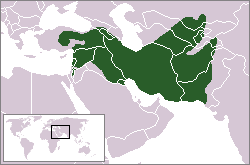
The Seleucid Empire ( /sɨˈlsɪd/; from Greek: Σελεύκεια, Seleύkeia) was a Greek-Macedonian state created by Seleucus I Nicator following the carve up of the empire created by Alexander the Great following his death.[4][5][6][7] Seleucus received Babylonia and from there expand his dominions to include much of Alexander's near eastern territories. At the height of its power, it included central Anatolia, the Levant, Mesopotamia, Persia, Turkmenistan, Pamir, Afghanistan and Pakistan.


Sebastian=سيباستيان


Sebastian=سيباستيان
ONLINE ETYMOLOGY DICTIONARY:
Sebastian
masc. proper name, from L. Sebastianus, from Gk. Sebastianos, "man of Sebastia," a city in Pontus that was named for Augustus Caesar, first Roman emperor, from Gk. sebastos "venerable," a translation of L. augustus, the epithet of Caesar.


leopard=ليوبارد


leopard=ليوبارد (tradename?)
ONLINE ETYMOLOGY DICTIONARY:
leopard (n.)
late 13c., from O.Fr. lebard, leupart (12c., Mod.Fr. léopard), from L.L. leopardus, lit. "lion-pard," from Gk. leopardos, from leon "lion" + pardos "male panther," which generally is said to be connected to Skt. prdakuh "panther, tiger." The animal was thought in ancient times to be a hybrid of these two species.

constellation Leo=كوكبة ليو


constellation Leo=كوكبة ليو
ONLINE ETYMOLOGY DICTIONARY:
Leo
zodiac constellation, late O.E., from L. leo "lion" (see lion). Meaning "person born under the sign of Leo" is from 1894. Leonid "meteor which appears to radiate from Leo" is from 1868. The annual shower peaks Nov. 14.
lion (n.)
late 12c., from O.Fr. lion "lion," figuratively "hero," from L. leonem (nom. leo) "lion; the constellation leo," from Gk. leon (gen. leontos), from a non-I.E. language, perhaps Semitic (cf. Heb. labhi "lion," pl. lebaim; Egyptian labai, lawai "lioness"). A general Germanic borrowing from Latin (cf. O.E. leo, Anglian lea; O.Fris. lawa; M.Du. leuwe, Du. leeuw; O.H.G. lewo, Ger. Löwe); it is found in most European languages, often via Germanic (cf. O.C.S. livu, Pol. lew, Czech lev, O.Ir. leon, Welsh llew). Used figuratively from c.1200 in an approving sense, "one who is fiercely brave," and a disapproving one, "tyrannical leader, greedy devourer." Lion's share "the greatest portion" is attested from 1701.


Scythian=السكيثيين


Scythian=السكيثيين
ONLINE ETYMOLOGY DICTIONARY:
Scythian
1540s, from L. Scythia, from Gk. Skythia "ancient region along the north coast of the Black Sea," from Skythes "a Scythian."

Scorpio=سكوربيو


Scorpio=سكوربيو
ONLINE ETYMOLOGY DICTIONARY:
Scorpio (n.)
zodiacal constellation, late 14c., from L. scorpio "scorpion" (see scorpion). The meaning "person born under or ruled by the sign of Scorpio" is recorded from 1968.
scorpion (n.)
early 13c., from O.Fr. scorpion, from L. scorpionem (nom. scorpio), extended form of scorpius, from Gk. skorpios "a scorpion," from PIE root *(s)ker- "to cut" (see shear). The Spanish alacran "scorpion" is from Arabic al-'aqrab.

scleroderma=سكليرودرما


scleroderma=سكليرودرما
ONLINE ETYMOLOGY DICTIONARY:
scleroderma (n.)
1866, from Modern Latin, from Gk. skleros "hard" (see sclerosis) + derma "skin" (see derma).
derma (n.)
"skin beneath the epidermis," 1706, from Mod.L. derma, from Gk. derma (gen. dermatos) "skin," from PIE root *der- "to split, peel, flay" (see tear (v.)).
sclerosis (n.)
"morbid hardening of the tissue," late 14c., from M.L. sclirosis "a hardness, hard tumor," from Gk. sklerosis "hardening," from skleros "hard," related to skellein "to dry up, parch," from PIE *skle-ro-, from root *skele- "to parch, wither."


Schist=الشست صخر متبلر


Schist=الشست صخر متبلر
ONLINE ETYMOLOGY DICTIONARY:
schist (n.)
1795 (earlier schistus, c.1600), from Fr. schiste, from L. schistos lapis "stone that splits easily" (Pliny), from Gk. skhistos "divided, separated," from skhizein "to split" (see shed (v.)). The rock splits easily in layers. Liddell and Scott says Greek skhistos lithos was "probably talc."


Thursday, 13 December 2012

scenario=السيناريو


scenario=السيناريو
ONLINE ETYMOLOGY DICTIONARY:
scenario (n.)
1878, "sketch of the plot of a play," from It. scenario, from L.L. scenarius "of stage scenes," from L. scena "scene" (see scene). Meaning "imagined situation" is first recorded 1962.
scene (n.)
1530s, "subdivision of an act of a play," also "stage-setting," from M.Fr. scène (14c.), from L. scaena, scena "scene, stage," from Gk. skene "scene, stage," originally "tent or booth," related to skia "shadow, shade," via notion of "something that gives shade," from PIE root *skai- "to shine, flicker, glimmer" (see shine).

Meaning "place in which the action of a literary work occurs" is attested from 1590s; general sense (non-literary) is recorded from 1590s. U.S. slang sense of "setting or milieu for a specific group or activity" is attested from 1951 in Beat jargon. Meaning "stormy encounter between two or more persons" is attested from 1761. Behind the scenes (1660s) is an image from the theater, "amid actors and stage machinery" (where patrons are not admitted). Scene of the crime (1923) first attested in Agatha Christie.


sardine=سمك السردين


sardine=سمك السردين
ONLINE ETYMOLOGY DICTIONARY:
sardine (n.)
early 15c., from L. sardina, from Gk. sardine, sardinos, often said to be from Sardo "Sardinia" (see Sardinia), the Mediterranean island, near which the fish were probably caught and from which they were exported. But cf. Klein: "It is hardly probable that the Greeks would have obtained fish from so far as Sardinia at a time relatively so early as that of Aristotle, from whom Athenaios quotes a passage in which the fish sardinos is mentioned." Colloquial phrase packed like sardines (in a tin) is recorded from 1911


urethane=يوريتان


urethane=يوريتان
ONLINE ETYMOLOGY DICTIONARY:
urethane
1838, from Fr. uréthane (Dumas, 1833), from urea + ethane.
urea
1806, Latinized from Fr. urée (1803), from Gk. ouron "urine" (see urine).
urine (n.)
early 14c., from Old French urine (12c.), from Latin urina "urine," from PIE *ur- (cf. Greek ouron "urine"), variant of root *awer- "to moisten, flow" (cf. Sanskrit var "water," Avestan var "rain," Lithuanian jures "sea," Old English wær, Old Norse ver "sea," Old Norse ur "drizzling rain").
ethane (n.)
1873, from ethyl + -ane.
ethyl
1838, modeled on Ger. äthyl (Liebig), from Gk. aither (see ether) + hyle "stuff." Ethyl alcohol, under other names, was widely used in medicine by 13c.
ether (n.)
late 14c., "upper regions of space," from O.Fr. ether and directly from L. aether "the upper pure, bright air," from Gk. aither "upper air; bright, purer air; the sky," from aithein "to burn, shine," from PIE root *aidh- "to burn" (see edifice).

In ancient cosmology, the element that filled all space beyond the sphere of the moon, constituting the substance of the stars and planets. Conceived of as a purer form of fire or air, or as a fifth element. From 17c.-19c., it was the scientific word for an assumed "frame of reference" for forces in the universe, perhaps without material properties. The concept was shaken by the Michelson-Morley experiment (1887) and discarded after the Theory of Relativity won acceptance, but before it went it gave rise to the colloquial use of ether for "the radio" (1899).

The name also was bestowed c.1730 (Frobenius; in English by 1757) on a volatile chemical compound known since 14c. for its lightness and lack of color (its anesthetic properties weren't fully established until 1842).


orthodox=أرثوذكسي


orthodox=أرثوذكسي
ONLINE ETYMOLOGY DICTIONARY:
orthodox (adj.)
mid-15c., of opinions, faith, from L.L. orthodoxus, from Gk. orthodoxos "having the right opinion," from orthos "right, true, straight" (see ortho-) + doxa "opinion, praise," from dokein "to seem," from PIE root *dek- "to take, accept" (see decent). As the name of the Eastern Church, first recorded in English 1772; in reference to a branch of Judaism, first recorded 1853.
ortho-
before vowels orth-, word-forming element meaning "straight, upright, rectangular, regular; true, correct, proper," now mostly in scientific and technical compounds, from Gk. ortho-, stem of orthos "straight, true, correct, regular," from PIE *eredh- "high" (cf. Skt. urdhvah "high, lofty, steep," L. arduus "high, steep," O.Ir. ard "high").


Ulysses=يوليسيس


Ulysses=يوليسيس
ONLINE ETYMOLOGY DICTIONARY:
Ulysses
Latin name for Odysseus, from L. Ulysses, Ulixes. Famous for wandering as well as craftiness and ability at deceit. For -d- to -l- alteration, see lachrymose.
Odysseus
king of Ithaca, from Gk. Odysseus (L. Ulysses), of unknown origin, perhaps related to odyssasthai "to be grieved at, be angry at."


protozoan=بروتوزوا


protozoan=بروتوزوا
WIKIPEDIA
Protozoa are a diverse group of unicellular eukaryotic organisms,[1] many of which are motile. Originally, protozoa had been defined as unicellular protists with animal-like behavior, e.g., movement. Protozoa were regarded as the partner group of protists to protophyta, which have plant-like behaviour, e.g., photosynthesis.

myETYMOLOGY

Etymology of the English word protozoan

the English word protozoan
using the English suffix -an
derived from the English word Protozoa
derived from the New Latin word protozoan
derived from the Greek word zoon, ζῶον (animal; a live thing; an animal)
derived from the Proto-Indo-European root *gʷei- (to live)
using the Byzantine Greek prefix proto-, πρωτο-

Date

The earliest known usage of protozoan in English dates from the 19th century.

Usage

Word found in Modern English


Protoplast=بروتوبلازمي


Protoplast=بروتوبلازمي ???
Protoplast, from the ancient Greek πρῶτον (first) + verb πλάθω or πλάττω (to mould: deriv. plastic), initially referred to the first organized body of a species.

protium=البروتيوم

-->
protium=البروتيوم

myETYMOLOGY

Etymology of the English word protium

the English word protium
using the English suffix -ium
using the English prefix prot-
derived from the New Latin word protium
derived from the Greek word protos, πρῶτος (first; foremost (in time, place, order or importance))
derived from the Proto-Indo-European root *per
using the Latin suffix -ium
using the Latin prefix proto-
derived from the Byzantine Greek prefix proto-, πρωτο-

Date

The earliest known usage of protium in English dates from the 20th century.

Usage

Word found in Modern English


WIKIPEDIA

In physics and chemistry, protium refers to hydrogen-1, the most common isotope of the element hydrogen, with one proton and no neutrons
  • Protium (plant) refers to a genus of chiefly tropical American trees in the family Burseraceae, having fragrant wood
  • Protium (computer language) is a universal, symbolic programming language system
  • In medicine, Protium is a commercial name for pantoprazole, a so-called "proton inhibitor" drug

Tuesday, 11 December 2012

Xerox=زيروكس (tradename)


Xerox=زيروكس (tradename)
ONLINE ETYMOLOGY DICTIONARY:
Xerox
1952, trademark taken out by Haloid Co. of Rochester, N.Y., for a copying device, from earlier xerography "photographic reduplication without liquid developers" (1948), from Gk. xeros "dry" (see xerasia) + -ography as in photography. The verb is first attested 1965, from the noun, despite strenuous objection from the Xerox copyright department. Related: Xeroxed; Xeroxing.